Showing posts with label etymology. Show all posts

Wednesday, June 2, 2010

Kalmia latifolia

As I mentioned earlier this week, I've been doing a lot of traveling lately. Last Tuesday I went to Ocean City, New Jersey to meet with the town's Environmental Commission to talk about native plants. Two weekends before, I was helping my mom out with some spring cleaning. When I was on the bus going home after that weekend, I noticed tiny hints of pink in the woods next to the Garden State Parkway. I knew immediately that they were Kalmia latifolia or Mountain Laurel.


People who have tried to get this plant to thrive in their garden probably look at this shot of Kalmia, growing beautifully on the side of the Garden State Parkway, and grit their teeth. The plant is notoriously difficult. As the common name implies, the plant does best in well drained soil (like, on the sides of mountains, or here, in extremely sandy soil). I see it in South Jersey a lot and of course, it's ubiquitous in the Appalachian.


Kalmia is in the Ericaceae or blueberry family. The foliage and its need for acidic soil is similar to another Ericaceous plant, the Rhododendron. But the flowers are quite unique. I love the flower buds before they open - they look almost like the hard candy cake decorations you can buy at the grocery store.


The plant is called Kalmia after Pehr Kalm who sent samples of the plant to Linnaeus. Latifolia means wide leaves.


This is a very, very pale pink plant, but you can find deeper pinks, like the color of ballet shoes. In either case, they are lovely.


I'm sending this out from Hawaii, so, Aloha! I'll be tweeting pictures occasionally, but won't be blogging much.

Tuesday, June 1, 2010

Mystery Geranium??

Goodness. Things here have been busy. I am (most likely) going back to Hawaii this Thursday. ...The construction schedule on that job isn't a moving deadline so much as a sprinting deadline. Every day is different story/crisis/strategy. I'll be in Hawaii for a week for work and then, hopefully, another whole week for vacation. I'm hoping to spend some time on the Big Island, to visit Volcanoes National Park, Mauna Kea and Rainbow Falls. If you have any recommendations for hotels (particularly in the Hilo area) please let me know!

In addition to an upcoming trip, I have an upcoming move and have been consistently setting up appointments with clients in the DC area. I've spent so much time on a bus between NY, NJ, DC and Philly lately, I'm beginning to feel like Ratso Rizzo (though hopefully sans the untimely end).

To wit: I've been neglecting this blog a bit and haven't been snapping many photos. It's gotten so bad that I had to consult the archives and find a photo from this time last year.


Which brings me to the Geranium species we have here, growing in the Liz Christy Garden. At first, I cavalierly applied the species name maculatum to this plant, but then wondered, could it be G. sanguineum instead? Or maybe it's G. macrorrhizum, the bigroot geranium (presumably the roots are big because it has a particularly good symbiotic relationship with mvcorrhiza the nitrogen-fixing fungus beneficial to so many plants). Suffice to say, I am stumped. Wikipedia states that there are over 400 species of this genus and I just don't feel equipped to hazard a guess. For all I know it could be cultivated so aggressively that it's no longer applied to any species (see Geranium 'Rozanne'). If you have a guess or you outright know what this plant is, please do share with us!


Now then, a bit about the genus itself. The common name for Geranium is cransebill. That's because when the flower goes to seed, it forms a tall column of seeds that will spring open when they are ready to be spread. The column itself looks like the bill of a crane. This also accounts for the plant's scientific name - geranos is an ancient Greek word for 'crane'. The perennials are generally hardy and bloom this time of year in shades of pink, blue and white. I love the foliage which has a sharp aroma when crushed.

You could be wondering, but this plant doesn't look like the annual geraniums I buy...! That's because the geraniums sold as annual plants are technically Pelargonium. They used to be classified as the same genus but have since been separated into its own genus.

Wednesday, May 26, 2010

Green Hawthorn

I was in my old neighborhood in the Lower East Side yesterday and saw a row of trees from across the street. I thought they may have been hawthorns, though was doubtful. It would seem like they would have been long past blooming this late in the spring. But sure enough, I found the entire block of Stanton Street was planted with Crataegus viridis or green hawthorn.


As you can see from the photo below, the bloom has dulled a bit and I'm sure these specimens looked much better a week ago. But I've wanted to blog about this plant for so long and have yet to get around to it so I'm not going to wait a whole other year!


Crataegus viridis is a small ornamental flowering tree with corymbs of white flowers in mid spring. The flowers are not as showy or colorful as a Malus or Prunus but they are quite lovely. And hawthorns have several other advantages to offer. Namely, depending on the cultivar, the plant is laden with showy, persistent berries in the fall and winter. 'Winter King' has long been a favorite due to it's gorgeous fruit set each year.


New leaves are quite different in shape
than the more mature ones.


Another advantage is this plant's status as a native to the southeastern US. Perhaps related to this, the plant is very tough and is not prone to the many diseases that haunt crabapples.


The bark is somewhat fibrous looking,
with longer vertical splits.


Finally, hawthorns provide habitat to many local wildlife species. The berries provide food for birds and the plant itself is a great supporter of butterflies. In fact, wikipedia has a great list of butterfly and moth species that find sustenance from this tree. However, one species that does not like the hawthorn is deer. Which is another terrific advantage. For the most part, deer avoid foraging on this tree, unless they are really, really hungry.


This could have something to do with the large thorns on the tree as well. The one above is a new thorn, but as they age, they harden into sharp, woody needles. I was on a job site at the zoo once and (not prepared, and wearing the wrong type of shoe) a needle went clear through the sole of my shoe and into my heel. It hurt. A lot.


Hawthorns are named as such because one definition of "haw" is "fruit". It can also mean hedge and in England Crataegus monogyna is often used as a hedge. Crataegus itself is derivative of the Greek work 'kratos' which means 'strength'. The origin refers to the hardness of hawthorn wood.

Wednesday, May 12, 2010

Artocarpus atilis

Here in Waimea Valley Botanical Garden, we now visit the breadfruit tree, or Artocarpus atilis. I saw this tree elsewhere in Honolulu and was always struck by the huge feathery leaves. With such big leaves (check out the bottom pic, my foot's about 8" long so the leaf must be close to 20") you'd expect a coarser texture in the canopy but the deep narrow leaf sinuses soften the whole look.


Sadly, this member of the mulberry (Moraceae) family was not in fruit, as I would have loved trying it out. It's called breadfruit, obviously enough, because the plant is very, very starchy. It's about a quarter carbs and the rest is water. Because of it's starchiness, it's often baked or fried.


Breadfruit is also a very high-fruiting tree, producing impressive fruit yields. In fact, Captain William Bligh and his infamous Bounty crew was tasked with harvesting breadfruit from Tahiti so the British could cultivate it in the Caribbean. They aimed to do so because the plant would be a fast and cheap source of food for British slaves. Ugh.

Artocarpus is literally Greek for breadfruit. Artos means bread and carpus means fruit or body.

Monday, May 10, 2010

Bird's Nest Fern

We have talked about epiphytes a few times on this blog and really, there can't be a better place to revisit the subject than in a valley forest in Hawaii. Below, you can see several different epiphytes growing in the canopy of a monkey pod tree (Albizia saman, more on that later).


Perhaps most beautiful are the apple green leaves of bird's nest fern (Asplenium nidis). Bird's nest ferns share their genus with 700 other species, some of which are very similar and often confused with Asplenium nidis.


This particular species can grow in trees as it is above or can grow terrestrially. They are also popular houseplants. Many of the species of Asplenium are generally referred to as spleenworts. This knowledge may give us pause as we consider the genus name again: Asplenium literally means "without spleen". It was thought, due to the spleen-shaped spores on some species of this genus, that this plant would help reduce swelling of the spleen.


Above you see some additional epiphytes, including staghorn fern (Platycerium) and what appears to be an epiphytic bromeliad, perhaps Nidularium.

Thursday, May 6, 2010

Spathoglottis plicata

Spathoglottis plicata is another one of the plants I saw on my nursery visits in Oahu. I was struck by the great, strappy leaves - they almost remind me of Acorus leaves. And of course, I am an absolute sucker for this shade of deep pink. I love it.


Even from afar, something about this plant says 'orchid' and sure enough when you look at the individual flowers, they look like miniature Vandas. Unlike Vanda, Spathoglottis is a terrestrial orchid, that is, they don't grow epiphytically. Instead they grow in soil like any other herbaceous plant.


Spathoglottis literally means 'spathe tongue' and refers to the tongue-like flower lip. Plicata means 'pleated' and refers to the leaves.

Wednesday, April 14, 2010

Crabapples

Like last week's post on daffodils, today's post is sorely overdue. It's about one of my favorite spring-blooming ornamental trees: the crabapple.

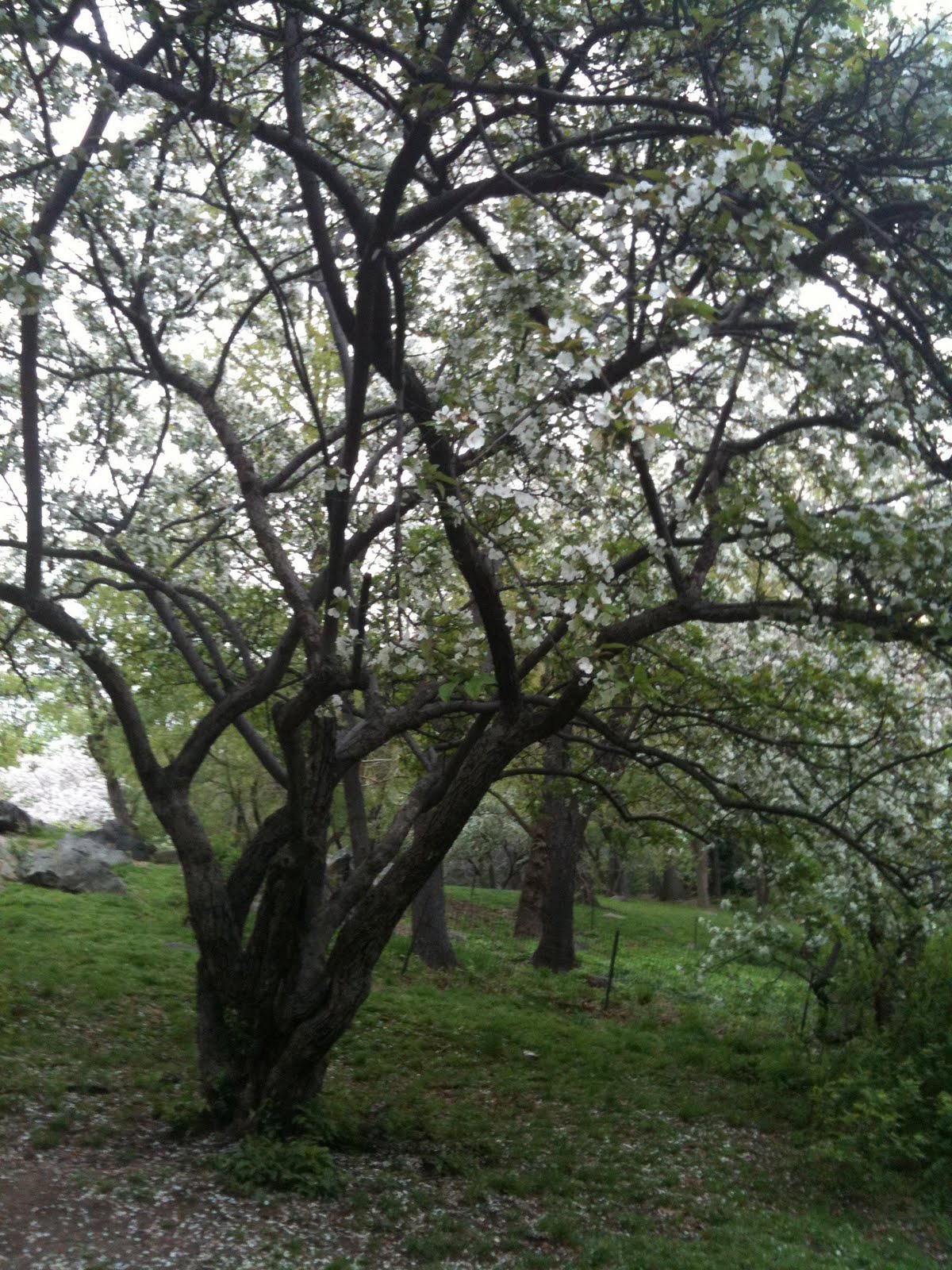
I simply love crabapples. There's something so wild and unsophisticatedly beautiful about them. And of course, many of them are like the two specimens below: utterly laden with flowers.


I'd say this pink is just about the perfect hue (that is, until I consider the redbud, also blooming now). As you can see, the flowers open up a darker pink then slowly turn lighter. The single flowers of five petals are not as fussy or hybridized as the heavy double flowers of a cherry, and the stamens on a crabapple are quite showy too.


It probably seems a little silly to call a tree "unsophisticatedly beautiful" (and spell check disapproves) but if you look at the branching habit below, perhaps you'd agree. There's a stubby, wild character to the tree's overall shape that makes them appear a little less cookie-cutter than a flowering cherry. Though I'm sure we can find plenty of lollipop-shaped crabapple cultivars.


I'm not trying to make this blog post a "crabapple vs. cherry" discussion, but I often feel Malus is overlooked this time of year for the benefit of their showier relative (indeed both are in the Rosaceae family). And... since we're enumerating the merits of this plant, I'd have to add crabs have lovely fall color and showy fruit (though, cherries have good fall color too).

Crabapples or Cherries? It's like Betty or Veronica, the Beatles or the Stones. What do you like most?


A bit on etymology: Malus is derivative for the Greek word for apple or the more general Greek word for fruit. The Latin word for apple is also Malus and, interestingly enough, the word for evil ('malum') derives from the word for apple. This evidently refers to the story of Adam and Eve and equating apples with evil. It's also worth noting that the precursor to this tale of an infamous apple involves the Greek Goddess of Discord, Eris. Eris was miffed because she wasn't invited to a wedding, so she tossed an apple engraved with "for the most beautiful" to the wedding guests in a strange yet successful attempt to rile up the competitive spirits of Hera, Athena and Aphrodite.


Wednesday, April 7, 2010

Stachyurus praecox

I absolutely love it when you are walking around some hidden corner of a botanical garden and discover a new plant - it's like finding a twenty dollar bill in recently-unpacked summer clothes. I saw this from afar and was intrigued. The hanging racemes almost looked like little beaded curtains.


Turns out this plant is Stachyurus praecox or spike-tail. It's a Japanese native with beautiful, creamy white flowers in racemes that are easily 6" long. Evidently the spring foliage is a bright chartreuse, however the fall color is unremarkable.


Stachy- means 'spike' and oura means 'tail'. Thus the genus name and common name both refer to the flowers. Praecox derives from the Latin word praecoquere which means 'early,' 'preripened' or 'unseasonable.' We can even break that word down further: prae means 'before' and coquere means 'to cook' or 'boil'.


These blossoms should last a bit longer, so if you check out the Orchid Show before it closes this Sunday, walk around to the south side of the conservatory and visit this hidden treasure.

Wednesday, March 24, 2010

Snow Azalea

Well, first of all, if any common name conjured up the this time of year, I think it would have to be 'snow azalea' - the common name for Rhododendron mucronulatum. It's called that because it blooms so early in the spring that it could be sitting on a few inches of snow. I'm happy to say that when I encountered this plant this morning in Central Park, this was not the case.


On a personal note, this photo wasn't taken with my trusty Canon, but instead with a new toy - my new iPhone. There's a special joy in having this; now I can listen to streaming radio on a run in the park and take snapshots like this. Of course the quality's not quite as good, but it beats retracing my steps this Saturday with a regular camera, only to find the blooms have fallen.


Back to the plant. Rhododendron mucronulatum is native to Korea and parts of East Asia. It's natural habitat is on rocky slopes at elevations of one to five thousand feet. You can see how it would then enjoy this location, on a hillside in the park.

As I've mentioned before, Rhododendron, in Greek, literally means rose-tree (rhodo: rose; dendron: tree). The species name essentially means little points, referring to the small points on the end of the leaves. Evidently, when crushed, the leaves emit a pleasant fragrance. Though we need a bit more time before we can test that out.

Thursday, March 11, 2010

Nepenthes densiflora

So how is it, that after more than two years of writing this blog, I've yet to mention what is perhaps the most infamous of plant types - the carnivorous plant? Well, I'll delay no longer and share some images of Nepenthes densiflora, which can also be referred to as pitcher plants or monkey cups.

To be utterly specific, the term pitcher plant refers to two different families of carnivorous plants: Nepenthaceae, which are old world vining plants and Sarraceniaceae, which are terrestrial new world pitcher plants. Nepenthes is the only genera in its family, whereas three genera exist in the Sarraceniaceae family.


Nepenthes
leaves initially look quite ordinary, but soon a tendril forms at the tip which eventually becomes a pitcher or cup. The "lid" that forms above the pitcher is not to keep insects from escaping but instead is to protect the cup as it develops. When the pitcher is finally ready to capture its prey the lid opens more fully.


When the cup gets larger, it begins to inflate with air and consequently it collects liquid. The plant begins to emit an odor of nectar to entice insects. The insect enters the pitcher - perhaps alighting on the toothed peristome (rolled leaf) at the top of the cup. When it tries to walk on the peristome, the surface essentially flakes away, causing it to slip down the sides of the pitcher and into the liquid. As the insect struggles to escape, the movement triggers plant glands to emit digestive acids which can render a midge fly to a mere memory in hours. The largest of the pitchers, Nepenthes rajah can even digest mice!


Nepenthes is not the only beneficiary of the prey it traps. Over 150 species have adapted to survive the diabolical morphology of the pitcher plant. Mosquito larvae live in the pitcher and find sustenance in the decaying remains of insects and some species of Nepenthes even have developed "pockets" in their stems to provide habitat for ants. The ants crawl into the pitcher to help themselves to a freshly-trapped fly, bring the fly to the peristome and dismember it. Smaller pieces of the fly fall back into the phytotelma (a water body formed by a plant) and are digested. Crab spiders and frogs have also learned to benefit from some species of Nepenthes. However, that doesn't include Nepenthes rajah - which can make a diet out of frogs quite easily.


Nepenthes densiflora is native to the Sumatran highlands and thrives best in elevations of 8000 feet or more. The genus name is compliments of Linnaeus himself. It's assumed by most that he was referring to the mythological elixir Nepenthe which is referenced in Homer's Odyssey.

Wednesday, February 17, 2010

Ranunculus, and a plaintive plea for spring

I am so, so very sick of this snow. February is, to me, the bitterest month. It's cold, it's bleak and this month, the snow has been relentless. I've yet to see even the tiniest bit of Crocus foliage sprout and the snow makes it hard to even spend much time outdoors.

But, the days are lengthening, ever so slowly. And there is always the Duane Reade official sign of spring, the Peep (TM):


It's getting me so rammy that I finally decided to take some snapshots of plants at a florist. So I walked over to Adore Floral in Noho to see what they had blooming in a climate-controlled showroom.


I'll post a few other shots later this week but today we'll focus on Ranunculus asiaticus, or the Persian buttercup. This species of Ranunculus is native to the Mediterranean region and is a protected flower in Israel. It prefers a dry light soil, hot summers and mild winters.


Because it comes in a wide variety of colors and the big flower heads (with rows and rows of petals), it's a popular favorite in the floral industry, though the blossoms are still quite fragile.


Ranunculus are commonly called buttercup due to the buttery yellow color of another Ranunculus species, R. acris. Ranunculus itself is Latin for "little frog" (Rana=frog) because some species of this genus can be found near wetlands, which are also frequented by frogs.


Speaking of etymology, if the species name acris caught your eye, you'd be interested to know that indeed it is given this name because the plant has a bitter acrid taste that can be fatal to livestock if ingested fresh. It's unlikely, however that a cow or horse would eat much of it, due to the taste and the mouth blisters that animals will get after eating only a little of this plant. If humans handle the plant too much, they will also get a case of dermatitis caused by chemicals that can be released from the plant.

Monday, November 30, 2009

High Line, Perennials


Even though it was late November when I visited the High Line, there was still a fair amount of perennials in bloom.

If you didn't know plants well, you may pause when seeing this plant, thinking it's a spring crocus. It is a crocus, but it's Crocus pulchellus or autumn crocus. Like the word 'pulchritude' pulchellus is derived from the Latin word for beautiful. I only saw one of these plants in the whole park and I wonder if some of them didn't survive since most bulbs are planted in the fall and not spring.


Aster tataricus, or tartarian aster, was a new plant for me. I recognized the flowers instantly as an aster or aster-like plant, but the coarse, dentate foliage was unlike the leaves I usually associate with the genus.


It turns out that Aster tartaricus root has been used by Chinese cultures as an expectorant, antifungal and antibacterial for over 2000 years. There is also a cancer-fighting chemical in the root though its success is not clearly documented.


The photos below are that of Knautia macedonica, or pincushion plant. You may recognize it as similar to the more ornamental Scabiosa, also called pincushion plant, and indeed the two are closely related.


Knautia is named for a botanist, but I found myself wondering what the root word was for its cousin, Scabiosa. Turns out that the rough leaves of Scabiosa were thought to be a cure for scabies and the name Scabiosa was applied.


Later this week we'll look at some of the grasses, shrubs and trees.

Thursday, October 29, 2009

Sugar Maple and a Brief Explanation of Fall Color

When it comes to fall color, the sugar maple (Acer saccharum) may be king.


This specimen is turning yellow, but you can find sugar maples turn fiery orange and red as well.

A commenter asked earlier this week why leaves turn different colors in the fall, and now I'm going to attempt to answer in just a few short sentences....


Most people know that chlorophyll is the chemical compound in plants that is necessary for photosynthesis (the production of sugars and carbon dioxide in a plant). Chlorophyll is also a pigment that absorbs the blue and yellow colors from sunlight, making plants appear green. The more chlorophyll in a plant, the more green it appears (and also, the more energy it produces and in some cases, the faster it grows -- it's generally why green-leaved plants grow faster than their variegated counterparts).

In the fall - as the days become shorter and colder - a membrane grows between the twig and the leaf petiole which clogs up the flow of sugars and water between the leaf and the rest of the tree. This eventually prevents the chlorophyll from being productive and the compound breaks down.

That's where carotenes and anthocyanins - two other pigments in leaves - come in to play. These pigments exist in the leaf all year, but are overpowered by the presence of chlorophyll until autumn. The former absorbs blue-green and blue light, which means that the presence of carotene - once the chlorophyll is gone - can make a leaf look yellow. Anthocyanins absorb blue, blue-green and green light, which makes a leaf appear red. The amount of anthocyanins and carotene varies among species (and in the case of sugar maples, they vary among individual plants).


So now, when you see a tree that has yellow fall color, you can impress your friends by observing that said tree must have a high concentration of carotene. I'm sure they'll be fascinated!

Back to sugar maples, briefly. Sugar maples of course are responsible for maple syrup and, as the common name would imply, the tree's sap is quite sweet. They are also very hard-wooded trees and the lumber is used for basketball court floors, pool cues and bowling pins.

My students struggle with discerning differences between sugar, silver, Norway and red maples. I'll post some of these other species in the days to come. The important characteristics to look for in sugar maples are a smooth or entire leaf margin and furrowed bark. While Norway maples also have entire margins, their bark is more stripey (and the leaf petiole exudes a white milky substance). Unlike sugar maples, red maples have serrated edges and silver maples have deep leaf sinuses.

Acer comes from a Latin word for sharp - referring to the hard wood, which could be utilized to make spears. Saccharum means 'sugar' - like saccharine.

Wednesday, October 28, 2009

Grape Leaf Anemones

Over the years of working in high-end residential design, certain perennials have consistently been used - earning a loyalty from designers due to their long period of flowers, the heartiness (and hardiness) and simple beauty. Anemone tomentosa 'Robustissima' is definitely among that group.


It can start to bloom as early as August and lasts well into November. It's an elegant perennial with soft pink or white blossoms and foliage that, as the common name indicates, looks a bit like grape leaves.


Anemone is from the Greek word for wind, anemos - legend has it that anemone flowers sprouted from the tears wept by Aphrodite after the death of Adonis. Of course, I think that story would refer more to Anemone blanda, or windflower, which is a bulb native to Greece.

Monday, October 26, 2009

Yellowwood

Autumn really is a wonderful time of year for tree watching. Not just for the aesthetic pleasure of seeing various trees' leaves change from green to yellow, orange or red, but also because while this change is taking place, different trees will begin to reveal themselves to you.

For instance, the entry to Central Park near the 5th Avenue stop on the NR train has never slowed my pace very much. If I enter the park here, I usually rush down to the nearby pond (the one where we saw our friend taking a dip last August) and then begin to meander through the landscape.

But on Saturday, this yellow tree caught my eye before I'd even entered the park.


When I neared the tree I quickly realized it was yellowwood (or Cladrastis kentukea, or C. lutea). I was delighted. I love this tree, but until now I have only been able to show students a smallish specimen near the magnolias behind the Met, or the larger one in Jefferson Market Garden.


Yellowwood are fairly easy to identify. They have a pinnately compound leaf with leaflets quite larger than a honey locust, sophora or black locust. More specifically, the terminal leaflet is always broader in shape than the lateral leaflets. It is almost spatula-shaped, where the lateral ones are simple footballs.


Like those other trees with pinnately compound leaves, Cladrastis is in the Fabaceae or pea family (also considered the Leguminosae family). And, like other members of that family, the tree has long, pendulous sweetpea-like flowers in the late spring.


The bark is gray and smooth. If one were to trim a branch and look at the cut, they would see yellow heartwood, thus the common name.


Cladrastis comes from the Greek words klados (branch) and thraustos (fragile). clearly refers to a native range. The other species name, lutea, means yellow.