Showing posts with label Trees. Show all posts

Wednesday, May 26, 2010

Green Hawthorn

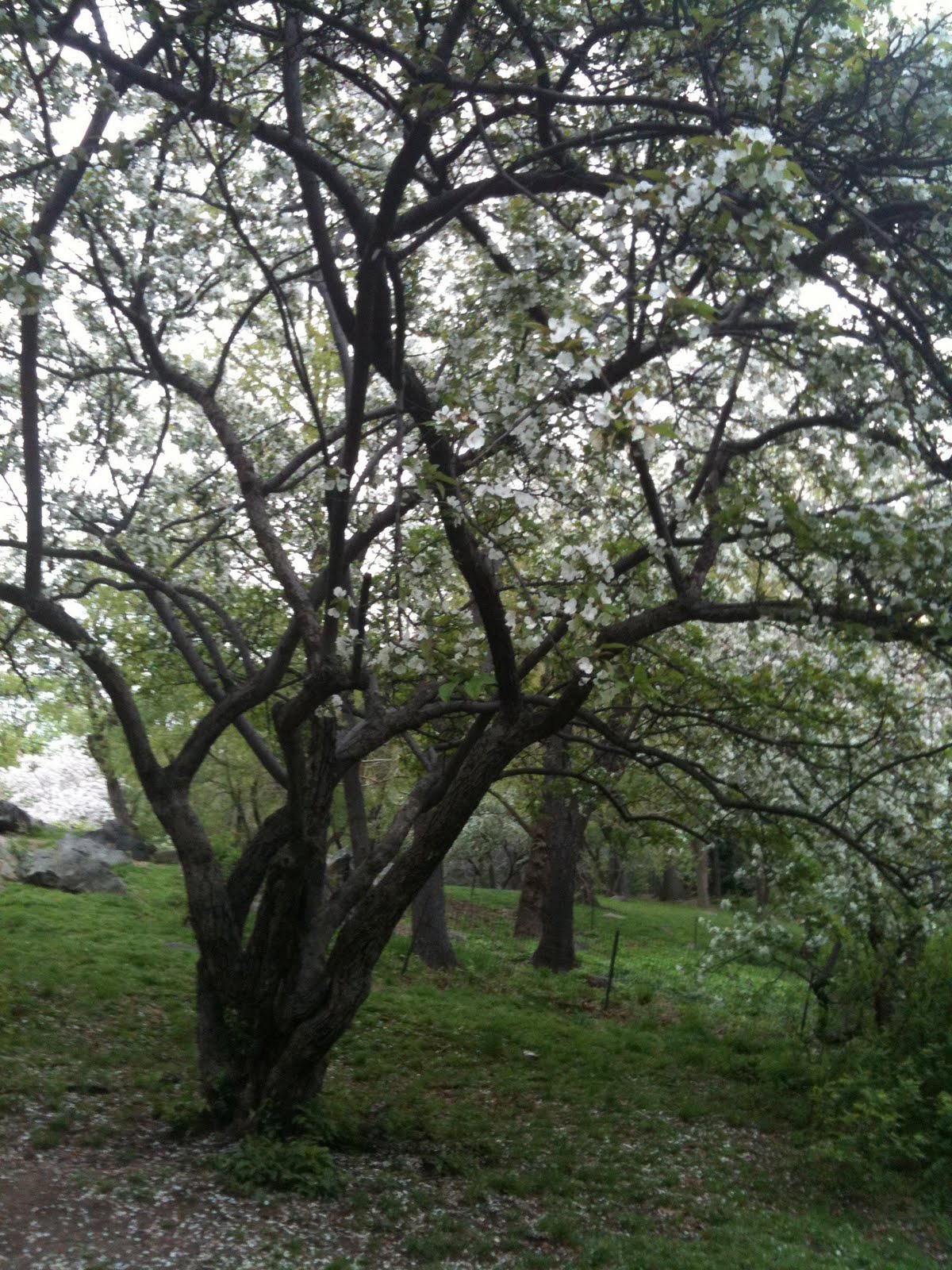
I was in my old neighborhood in the Lower East Side yesterday and saw a row of trees from across the street. I thought they may have been hawthorns, though was doubtful. It would seem like they would have been long past blooming this late in the spring. But sure enough, I found the entire block of Stanton Street was planted with Crataegus viridis or green hawthorn.


As you can see from the photo below, the bloom has dulled a bit and I'm sure these specimens looked much better a week ago. But I've wanted to blog about this plant for so long and have yet to get around to it so I'm not going to wait a whole other year!


Crataegus viridis is a small ornamental flowering tree with corymbs of white flowers in mid spring. The flowers are not as showy or colorful as a Malus or Prunus but they are quite lovely. And hawthorns have several other advantages to offer. Namely, depending on the cultivar, the plant is laden with showy, persistent berries in the fall and winter. 'Winter King' has long been a favorite due to it's gorgeous fruit set each year.


New leaves are quite different in shape
than the more mature ones.


Another advantage is this plant's status as a native to the southeastern US. Perhaps related to this, the plant is very tough and is not prone to the many diseases that haunt crabapples.


The bark is somewhat fibrous looking,
with longer vertical splits.


Finally, hawthorns provide habitat to many local wildlife species. The berries provide food for birds and the plant itself is a great supporter of butterflies. In fact, wikipedia has a great list of butterfly and moth species that find sustenance from this tree. However, one species that does not like the hawthorn is deer. Which is another terrific advantage. For the most part, deer avoid foraging on this tree, unless they are really, really hungry.


This could have something to do with the large thorns on the tree as well. The one above is a new thorn, but as they age, they harden into sharp, woody needles. I was on a job site at the zoo once and (not prepared, and wearing the wrong type of shoe) a needle went clear through the sole of my shoe and into my heel. It hurt. A lot.


Hawthorns are named as such because one definition of "haw" is "fruit". It can also mean hedge and in England Crataegus monogyna is often used as a hedge. Crataegus itself is derivative of the Greek work 'kratos' which means 'strength'. The origin refers to the hardness of hawthorn wood.

Tuesday, May 18, 2010

Monkey Pod Tree

I mentioned Albizia saman in last week's post about Asplenium and then promised to comment more on this lovely tree in the future. Well, that time is now.


First of all, what a beauty, eh? I am *in love* with the elegant, almost overreaching canopy. The form is so striking and, as common as this tree is in Oahu, I think I will always equate monkey pod tree with my wanderings on this trip.


Not that Albizia saman is native to the Hawaiian islands, it's instead native to Central and South America, distributed between Mexico and Brazil. Indeed, due to the region's geologic history, Hawaii is fairly sparse in terms of native plants. More often that not, the plants that are most popular here are native to other areas and were planted by colonists or passers-through. (Somewhat relevant to this information, in last week's post about breadfruit my friend Matthew asked if Artocarpus was endemic to Hawaii and it's not. It's native to the Malay peninsula and the surrounding islands.)


Here above is another shot of the tree pictured at the top of this post. You can gauge from the Monstera leaves below how big this trunk is. I'd say its diameter was probably around 9-10'. A woman at the Waimea Botanical Garden says the arborists speculate this specimen is over 200 years old. In that case it is quite like the "Samán de Güere" a Venezuelan national treasure and landmark. That specimen was originally recorded by Alexander von Humboldt, a German naturalist and one of the founders of biogeography, in his trip to South America between 1799 and 1804. You can see an old print of this Venezuelan icon here. Unfortunately, there's scant information about this tree online, in English (and my Spanish is pretty shoddy these days).


I know I'm quite smitten with a new species when I have a ton of photos of the feature I like so much (in this case, the branching habit) and one cursory shot of another key characteristic (in this case, the leaves). In fact, I was relieved to find I had even one picture of the species' pinnately compound leaves. Knowing that the leaves are pinnately compound, you could hazard a guess that Albizia is a member of the pea or legume family, and you'd be right. Technically these days, you'd say it is a member of the Fabaceae family, though Leguminosae is still commonly used and considered acceptable. In either case, Fabaceae trees have similar leaves and pea-pod like fruits. Other species of this family which we have previously discussed are Gleditsia, Robinia, Sophora, Lupinus, Cercis and Cladrastis.


Finally, on a very unscientific note, every time I look at this photo, I can hear Meryl Streep saying in her Danish accent "I had a farm in Africa." Indeed, monkey pod tree is related to Albizia amara, a tree that is found in the dry scrublands between Sudan and South Africa.

Wednesday, May 12, 2010

Artocarpus atilis

Here in Waimea Valley Botanical Garden, we now visit the breadfruit tree, or Artocarpus atilis. I saw this tree elsewhere in Honolulu and was always struck by the huge feathery leaves. With such big leaves (check out the bottom pic, my foot's about 8" long so the leaf must be close to 20") you'd expect a coarser texture in the canopy but the deep narrow leaf sinuses soften the whole look.


Sadly, this member of the mulberry (Moraceae) family was not in fruit, as I would have loved trying it out. It's called breadfruit, obviously enough, because the plant is very, very starchy. It's about a quarter carbs and the rest is water. Because of it's starchiness, it's often baked or fried.


Breadfruit is also a very high-fruiting tree, producing impressive fruit yields. In fact, Captain William Bligh and his infamous Bounty crew was tasked with harvesting breadfruit from Tahiti so the British could cultivate it in the Caribbean. They aimed to do so because the plant would be a fast and cheap source of food for British slaves. Ugh.

Artocarpus is literally Greek for breadfruit. Artos means bread and carpus means fruit or body.

Monday, May 10, 2010

Bird's Nest Fern

We have talked about epiphytes a few times on this blog and really, there can't be a better place to revisit the subject than in a valley forest in Hawaii. Below, you can see several different epiphytes growing in the canopy of a monkey pod tree (Albizia saman, more on that later).


Perhaps most beautiful are the apple green leaves of bird's nest fern (Asplenium nidis). Bird's nest ferns share their genus with 700 other species, some of which are very similar and often confused with Asplenium nidis.


This particular species can grow in trees as it is above or can grow terrestrially. They are also popular houseplants. Many of the species of Asplenium are generally referred to as spleenworts. This knowledge may give us pause as we consider the genus name again: Asplenium literally means "without spleen". It was thought, due to the spleen-shaped spores on some species of this genus, that this plant would help reduce swelling of the spleen.


Above you see some additional epiphytes, including staghorn fern (Platycerium) and what appears to be an epiphytic bromeliad, perhaps Nidularium.

Monday, April 19, 2010

Aloha! ...And other stuff

So, I am blogging today from beautiful, warm Honolulu, Hawaii.

I am here on a job until the end of next week. So my blog posts may be a bit spare. I had every good intention of blogging while here, but the first work day was pretty busy and I suspect that won't change. So, forgive me for a thin site this week.

But, before I go completely on hiatus, a few shots from Central Park, as of last week.

First up, Rhodotypos scandens, or jetbead.


Jetbead is one of those plants you never notice until it's blooming. It's a small, nondescript shrub with attractive jade-green foliage. But when it blooms, it's quite lovely. It used to be called white kerria, as the foliage resembles Kerria japonica but most people know it as jetbead now, named such for its black persistent berries. Rhodotypos is native to Japan and China and is invasive.


Another beauty in bloom right now is Halesia tetraptera or Carolina silverbell.


It's easy enough to discern why it's called silverbell; the lovely white blossoms hang like little bells. The seed pods are why it's given the species name tetraptera which literally means four-winged since the seed pods look like little starfruit.


This one below is a gorgeous mature specimen just northeast of the Central Park Bandshell.

That's it for now. I hope to tweet some photos from Hawaii this week so please follow me at twitter.com/jhornlandscape! If you don't well, then I will certainly have a wealth of blogworthy photos for when I'm back.

Wednesday, April 14, 2010

Crabapples

Like last week's post on daffodils, today's post is sorely overdue. It's about one of my favorite spring-blooming ornamental trees: the crabapple.

I simply love crabapples. There's something so wild and unsophisticatedly beautiful about them. And of course, many of them are like the two specimens below: utterly laden with flowers.


I'd say this pink is just about the perfect hue (that is, until I consider the redbud, also blooming now). As you can see, the flowers open up a darker pink then slowly turn lighter. The single flowers of five petals are not as fussy or hybridized as the heavy double flowers of a cherry, and the stamens on a crabapple are quite showy too.


It probably seems a little silly to call a tree "unsophisticatedly beautiful" (and spell check disapproves) but if you look at the branching habit below, perhaps you'd agree. There's a stubby, wild character to the tree's overall shape that makes them appear a little less cookie-cutter than a flowering cherry. Though I'm sure we can find plenty of lollipop-shaped crabapple cultivars.


I'm not trying to make this blog post a "crabapple vs. cherry" discussion, but I often feel Malus is overlooked this time of year for the benefit of their showier relative (indeed both are in the Rosaceae family). And... since we're enumerating the merits of this plant, I'd have to add crabs have lovely fall color and showy fruit (though, cherries have good fall color too).

Crabapples or Cherries? It's like Betty or Veronica, the Beatles or the Stones. What do you like most?


A bit on etymology: Malus is derivative for the Greek word for apple or the more general Greek word for fruit. The Latin word for apple is also Malus and, interestingly enough, the word for evil ('malum') derives from the word for apple. This evidently refers to the story of Adam and Eve and equating apples with evil. It's also worth noting that the precursor to this tale of an infamous apple involves the Greek Goddess of Discord, Eris. Eris was miffed because she wasn't invited to a wedding, so she tossed an apple engraved with "for the most beautiful" to the wedding guests in a strange yet successful attempt to rile up the competitive spirits of Hera, Athena and Aphrodite.


Tuesday, April 6, 2010

That Big Magnolia, Scaled....Sort of

As soon as I uploaded the photos I took of yesterday's giant star magnolia, I regretted that I hadn't taken a photo of it with a person or some other way to scale it.

Sure enough, within moments of publishing yesterday's post, I got an email asking how big it really was.


With some irreverence, I've attached a picture of the tree with Shaquille O'Neal photoshopped next to it. The Shaq's about 7' 1". I think he's pasted into this photo at about the right size, making this specimen about 45-60' high. No promises on that estimate though!

Monday, April 5, 2010

The Biggest Star Magnolia I've Ever Seen

So, I went to the NYBG's Orchid Show on Saturday, along with what seemed like most of the city. The conservatory was packed to the gills, but the show was lovely and one can't help but be awed by the quantity and variety of orchid species on display.

I'll certainly be posting about those plants in the weeks to come, but this week I'll focus instead on what's happening outdoors.


First up, this specimen, which is undoubtedly the biggest star magnolia (Magnolia stellata) I've ever laid eyes on. Amazing, isn't it? I've posted about Magnolia stellata before and have more than a few posts on the genus Magnolia as well. I don't have much to add today, save that I saw this at the NYBG grounds on the left of the path that leads directly to the conservatory from the cafe building. I was dumbstruck by the size and a little sheepish. I must have walked past this tree dozens of times and never paid much attention to it. Only when I saw it in bloom did I register what it was and how remarkable its size is. Shame on me.


It also made me a liar as far as my current students are concerned. Just last week we were speculating on the lifespan of this species. I guessed that they rarely last more than fifty odd years. However, this seemed to be grouped with some trees that were listed as 75-100 years old, so I would guess this specimen could easily be a septuagenarian!


Tuesday, March 2, 2010

Picea abies

Remember in December when I posted about Picea abies? Probably not -- who am I kidding? But in any case, I had written that I have seen more than one modest rancher dwarfed by these trees. On first glance, I thought that situation was being played out at the farmer's market near Dia:Beacon.


But after getting a closer look, that's not quite the case.


Sure enough, the Beacon farmer's market cabin was built around the Norway spruce. I suppose, were I a more intrepid blogger, I would have asked someone the back story about the tree. But I was quickly distracted by the wine tastings and hot apple cider.


Wednesday, February 24, 2010

Sycamores and Dia: Beacon

Last Sunday was a gloriously warm day for New Yorkers - of course, by late February, the bar for 'glorious' is set pretty low: I was thrilled to have temperatures surpass the 40° mark.

In any case, a friend and I celebrated this warmer weather with a trip to Dia: Beacon.


Dia: Beacon is a contemporary art gallery housed in a former cardboard box factory. The large, expansive rooms of the factory, which once housed industrial machinery, now are now indulgently large galleries, flooded with natural light from the pitched skylights. The massive size of the building also allows for quite a few massive (as if there are any other kind) Richard Serra pieces.


The trip itself is lovely as well. Metro North runs a line along the Hudson River and the walk from the train station to the gallery is less than half a mile. During the walk back to the train station, I couldn't help but pause and take a few pictures of this perfect specimen of sycamore (Platanus occidentalis).


I have mentioned sycamores before in my post about London plane trees. Indeed, London planes are a hybrid of sycamore and Platanus orientalis - the plane tree more often found in Europe. Sycamores have larger leaves and whiter bark. The base of the sycamore trunks also have a scaly bark, and only becomes a smooth exfoliating bark further up the tree.


This sycamore is located in a fairly typical microclimate. Sycamores are often found on slopes near riversides and can handle damp spring soil fairly well.


Friday, January 29, 2010

Thuja, Thuja, Thuja

Remember back in May when I posted those photos of Liriodendron tulipifera? At that time, the landscape installation had not been complete at the Cooper Square Hotel. Now all the paving, furnishings and additional plants have been installed, too.


I had been so tickled to see the tuliptree (an urban rarity) planted at this site and had high hopes that other off-the-beaten-path plant species would be included in the palette. Alas, I was underwhelmed when I saw that everything else is Thuja (arborvitae). Don't get me wrong -- arborvitaes are handy plants and can be used in a seamless green screen to powerful effect. For a modernish building like this hotel, I appreciate the intent.


...But this landscape just reminds me of what a friend once said at a diner over breakfast, "The thing about pancakes is that you're halfway through eating them and it's just more pancakes." Indeed. The landscape above is a bit monotonous. Also puzzling is the use of a bluestone random rectangular paving pattern. It's lovely, but it is so residential; it seems like a missed opportunity to do something contemporary and to keep in step with the building.


Now, then a bit about Thuja itself. I haven't named a species because frankly there are several of them and I have a hard time telling them apart. There's Thuja occidentalis (which is often cultivated for a darker, more vibrant wintertime green - the straight species gets yellowed in the winter), Thuja orientalis (which is cultivated to be more winter-hardy, as this species is tender in cold climates) and Thuja plicata (which has great foliage). T. orientalis, I should add, has actually been reclassified as either Biota orientalis or Platycladus orientalis but people in the landscape trade still consider it a Thuja. If you aren't confused enough by now, let's add that the common name for T. occidentalis is also white cedar, even though the plant isn't related to Cedrus but is instead in the cypress (Cupressaceae) family.

Thursday, December 17, 2009

Norway Spruce & Rockefeller Center

Since we are well into the holiday season, it seems appropriate to post on Picea abies or Norway Spruce.

Norway Spruces are probably recognizable to people living in the mid-Atlantic states, if not areas beyond, despite the fact that the plant is (as the common name suggests) native to areas between the Ural Moutains and Norway. It was introduced to North America during colonial times and has been a popular favorite since. It's often sold in a pot at plant nurseries as a 'live Christmas tree' that can be transplanted to the yard after the holidays. Of course, the subsequent danger is that it is planted too close to the house. I have seen more than one modest rancher dwarfed by these trees.


Norways are identifiable from other spruces by their almost pendulous habit. Long swooping branches have smaller branches, laden with needles, hanging down. In the past, I have likened this plant's habit to an Afghan dog. That's utterly ridiculous, I know, but my students seem to get it.


Picea
is derivative of the ancient Latin name for pitch (pix). That's because the Norway's wood is often used for pulp and paper. It is also used for a furniture varnish. New shoots are used in a spruce beer and finally, the roots of this tree can be used for rope.


Note the woody husk that is pulled from the branch along with the needle. That's quite typical with Picea abies.

Another key I tell my students is Picea=pierce. That's because the needles are quite sharp - they pierce your skin much more than a similar looking Fir (Abies) tree would.


Picea abies is also quite famous, because it is usually the tree used at Rockefeller Center. Which gives me the perfect segway to some photos of the NYBG train show:


Yes, there's 30 Rock itself (flanked by other New York sights such as the Chrysler Building and the Empire State Building), complete with the angel statues and even Prometheus.


Monday, December 14, 2009

Idesia & Yankee Stadium

More photos of the Holiday Train Show at NYBG today, but first, Idesia polycarpa or the Igiri tree.


I had never heard of Igiri tree before, but I was stopped in my tracks when I saw its elegant shape and the lovely chandeliers of red berries, contrasting so beautifully against the blue sky and green pines.


Idesia is a dioecious tree which means the male and female flowers exist on separate trees (remember dioecious is Greek for 'two houses'). This accounts for the reason you rarely see this tree (which also has yellow fragrant flowers in June) outside of a park setting -- you simply need too much room for the male and female(s) needed to make an impact.


Polycarpa of course means 'multiple fruit' which is a bit of an understatement in this case. . Idesia derives from Eberhad Isbarnd Ides, a 17th century explorer employed by the Russian Czar Peter the Great.

Back to the train show, below we have the old Yankee Stadium -- the model is based on the stadium before the 1976 renovations:


I particularly liked the red leaves used as flags.