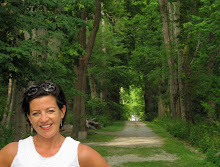
Hello!
Forgive me (SO MUCH) for not blogging for an entire month. It's terrible! Some of you know I am in transition. I started my own office, Jennifer Horn Landscape Architecture, this year and things are getting quite hectic. I also have moved to DC which makes this blog title a little inaccurate.
I think I have finally figured out a new title (ultimately, I decided against DC, Plants and Other Stuff) and hope to launch in the next week. Please be sure to visit me for the link when it finally is ready for viewing.
Thanks!!!!
Jennifer
Friday, August 6, 2010


Tuesday, June 29, 2010
Mauna Kea and Hawaiian Blueberry
One of the places I absolutely *had* to visit when I was on the Big Island was Mauna Kea, Hawaii's tallest mountain, reaching a height of 13,900' above sea level. Technically, it's the world's biggest mountain, measuring 30,000' from the base, which is at the bottom of the sea, to the tip.

It's also the site of the world's largest astronomical observatory, with 13 telescopes representing 11 different countries. The air in this microclimate is the some of the driest on earth, second only to Antarctica. This, in addition to the absence of cloud cover and light pollution, makes for excellent astronomical viewing conditions.

Warned that going to the summit individually is quite difficult (you definitely need four-wheel drive) and reluctant to bring a bunch of winter gear with me from the mainland (it's a chilly 32° at the summit) I signed up for a tour with Mauna Kea Summit Adventures. The tour picked me up at 4pm, and along with about 12 other people, we had a picnic dinner at the visitors center (elevation 9000') before going to the summit for sunset.

After the sunset, we descended back to 9000' for some stargazing. I saw Saturn and its rings, the Omega Centauri, constellations Sagittarius, Virgo and Leo, as well as the beautiful binary star, Albireo. We also learned a fair amount about night viewing and general astronomy. It was an excellent tour and quite educational. By the time I got back to the hotel, nearing midnight, I was more than a little awestruck by how truly insignificant we are and by the incomprehensible age of the galaxies. (Light years, as a concept, always trips me up. The Omega Centauri is around 15,000 light years away. I see it, but because of its distance, it may not really be there anymore. Only in 15,000 years could someone know if it existed in 2010. Discussing this brain-bending concept with the tour guide, he quipped, 'I think that's why insanity is more common among quantum physicists and astronomers.' ...I can't verify that, but can imagine that the sense of profound insignificance, combined with the fact that - in such a profession - you ask questions that can never be truly answered, may be a bit maddening at times.)

I suppose that's why I prefer plants. There aren't a lot in this biome, but there were enough. I saw the plant below when we stopped for a photo-op at around 11,000'. Does it look familiar to any east coasters?

Those bell-shaped flowers are a clue, perhaps. Also maybe the reddish hue to the foliage...But who am I kidding, you read the post title so you know it's a blueberry, or Vaccinium reticulatum. In Hawaii the plant is commonly called the 'ohelo. There are two species of Vaccinium in Hawaii, and both have some subspecies, too, varying slightly among the different Hawaiian islands. V. reticulatum is found in open woodlands and high elevations, while V. calycinum is found in wet, wooded areas.

The plant's berries, like our more local V. corymbosum, V. caesariense, or V. angustifolium, make wonderful jams or jellies or can be eaten fresh. They can be picked by visitors and locals but the maximum takeaway is 1 quart when picking in parkland. That's because the plant provides habitat and food to two endemic moths as well as the endangered nene, or Hawaiian goose.

It's also the site of the world's largest astronomical observatory, with 13 telescopes representing 11 different countries. The air in this microclimate is the some of the driest on earth, second only to Antarctica. This, in addition to the absence of cloud cover and light pollution, makes for excellent astronomical viewing conditions.

Warned that going to the summit individually is quite difficult (you definitely need four-wheel drive) and reluctant to bring a bunch of winter gear with me from the mainland (it's a chilly 32° at the summit) I signed up for a tour with Mauna Kea Summit Adventures. The tour picked me up at 4pm, and along with about 12 other people, we had a picnic dinner at the visitors center (elevation 9000') before going to the summit for sunset.

After the sunset, we descended back to 9000' for some stargazing. I saw Saturn and its rings, the Omega Centauri, constellations Sagittarius, Virgo and Leo, as well as the beautiful binary star, Albireo. We also learned a fair amount about night viewing and general astronomy. It was an excellent tour and quite educational. By the time I got back to the hotel, nearing midnight, I was more than a little awestruck by how truly insignificant we are and by the incomprehensible age of the galaxies. (Light years, as a concept, always trips me up. The Omega Centauri is around 15,000 light years away. I see it, but because of its distance, it may not really be there anymore. Only in 15,000 years could someone know if it existed in 2010. Discussing this brain-bending concept with the tour guide, he quipped, 'I think that's why insanity is more common among quantum physicists and astronomers.' ...I can't verify that, but can imagine that the sense of profound insignificance, combined with the fact that - in such a profession - you ask questions that can never be truly answered, may be a bit maddening at times.)

I suppose that's why I prefer plants. There aren't a lot in this biome, but there were enough. I saw the plant below when we stopped for a photo-op at around 11,000'. Does it look familiar to any east coasters?

Those bell-shaped flowers are a clue, perhaps. Also maybe the reddish hue to the foliage...But who am I kidding, you read the post title so you know it's a blueberry, or Vaccinium reticulatum. In Hawaii the plant is commonly called the 'ohelo. There are two species of Vaccinium in Hawaii, and both have some subspecies, too, varying slightly among the different Hawaiian islands. V. reticulatum is found in open woodlands and high elevations, while V. calycinum is found in wet, wooded areas.

The plant's berries, like our more local V. corymbosum, V. caesariense, or V. angustifolium, make wonderful jams or jellies or can be eaten fresh. They can be picked by visitors and locals but the maximum takeaway is 1 quart when picking in parkland. That's because the plant provides habitat and food to two endemic moths as well as the endangered nene, or Hawaiian goose.
Wednesday, June 23, 2010
Cibotium glaucum
On Monday I mentioned the tree ferns that populate the forests near the active volcano at Volcanoes National Park. Today, we'll take a closer look at the Hawaiian tree fern, or Cibotium glaucum, or hapu'u.

As you can see from the photo above, Cibotium can reach heights up to 8 meters. I encountered this forest - the upper canopy consisting of ohi'a and the understory of hapu'u - while walking to the Thurston Lava Tube in the park. The scale of these beautiful plants is awesome, in the truest sense of the word.

The fronds have a pure, clear green color, with small leaflets. The plant can be propagated by spores - the ones on the youngest fronds are usually most fertile.

The fiddleheads are actually the size of real fiddle or violin heads. Much like other ferns, frying or boiling the heads is part of the local cuisine.

The plants' trunk can be edible as well, but is not very tasty. I read on one site that the trunk is considered "famine food."

In addition to the edible parts of the plant, the shaggy base of the trunk - or the pulu - has been used as a soft filling for pillows and mattresses. This use reached a peak in the mid 19th century and large swaths of tree fern forests were almost irreparably degraded. Much like I mentioned Monday in regards to Metrosideros, these forests are now more carefully managed.

As you can see from the photo above, Cibotium can reach heights up to 8 meters. I encountered this forest - the upper canopy consisting of ohi'a and the understory of hapu'u - while walking to the Thurston Lava Tube in the park. The scale of these beautiful plants is awesome, in the truest sense of the word.

The fronds have a pure, clear green color, with small leaflets. The plant can be propagated by spores - the ones on the youngest fronds are usually most fertile.

The fiddleheads are actually the size of real fiddle or violin heads. Much like other ferns, frying or boiling the heads is part of the local cuisine.

The plants' trunk can be edible as well, but is not very tasty. I read on one site that the trunk is considered "famine food."

In addition to the edible parts of the plant, the shaggy base of the trunk - or the pulu - has been used as a soft filling for pillows and mattresses. This use reached a peak in the mid 19th century and large swaths of tree fern forests were almost irreparably degraded. Much like I mentioned Monday in regards to Metrosideros, these forests are now more carefully managed.
Monday, June 21, 2010
Metrosideros polymorpha (and Volcanoes!)
Well, I got back from Hawaii on Saturday and am now squarely within my last days as a full time New Yorker. I'll most likely work Monday - Wednesday for the next three weeks then finish up at my job (save a few hourly tasks to wrap up my Hawaii project).
Hawaii was wonderful, and thank goodness I scheduled three days on the Big Island. Otherwise, I'm afraid I would have spent far too much time "on call" for work, even if I officially had the day off. I highly HIGHLY (HIGHLY!) recommend the Big Island to any Hawaii-bound individual that is even a casual naturalist. The variety of ecosystems and the rugged beauty of this - the youngest of the Hawaiian islands - place is stunning.
I flew into Kona last Monday morning and immediately set off for Volcanoes National Park. "Why, it's only 90 miles!" I thought to myself, "I'll be there well within 2 hours."

Not so much. The winding roads through the big island - and their ever-changing elevations - definitely slows down the works and driving 90 miles really requires at least 2.5 hours of driving. Of course, as soon as I got to Volcanoes National Park and saw the Kīlauea Crater spewing sulfurous fumes, all that driving was worth it.

Large parts of the park were closed on my recent visit, since the volcano has been acting a bit differently lately. A few weeks ago it began spewing lava in a new location and as a result, the gases have been considered too dangerous to inhale in certain areas. If I had stayed 'til dark, I would have been able to see the red glow of lava further along the edges of the park (at the crater itself it primarily flows underground), but I wasn't up for a long, winding drive at night.

Now then. Let's get to the plants. It's pretty amazing to see a shrub with such a lovely flower on it blooming with an active volcano so nearby. This plant is Metrosideros polymorpha or ōhiʻa lehua. If it looks familiar, you could (maybe, possibly) remember a post I wrote that had some shots of Callistemon citrinus. These plants are both in the Myrtaceae or myrtle family and their flowers (with diminutive petals and brightly-colored, showy stamens) are quite similar.

This species of Metrosideros is endemic to Hawaii, meaning that it can only be found in the Hawaiian islands. Though it does have relatives in New Zealand that are quite similar. The species itself is highly variable and over the years varieties of Metrosideros polymorpha have been further categorized into new species, all equally endemic to Hawaii. Some of the variations we find among the Hawaiian species include the hairiness of the leaves (hairier in drier climates, as the hairs trap ambient moisture) and the color of the leaves (changing from green to greenish-gray to gray).

The species itself is highly adaptable. It can maintain itself as a small shrub or tower to 20+ meters. The incredibly light seeds can blow for miles in the wind and this is partly why the plant is often the first colonizer of post-volcanic, lava-laden landscapes. As it colonizes a lava field, it begins to degrade the rock into soil and provides perching locations for birds. Ultimately, the landscape succeeds into a fern forest, as can be found just a mile away from the Kīlauea crater itself (more on the ferns this week).

I was all too excited to pick up a book at the Volcanoes National Park visitor's center - Hawaii's Plants and Animals: Biological Sketches of Hawaii Volcanoes National Park - and it's a terrific read so far. When I was reading about Metrosideros the authors noted a curious phenomena with this plant: at times, massive swaths of ōhiʻa will die out. When biologists at the park first documented this, they immediately investigated whether a foreign pest or disease was the cause of such dieback, but no culprit was found. Instead, they can only determine that a heavy rain or drought can trigger this mass death. It seems to be part of the evolutionary hardwiring of the plant. Today that is problematic because, given the pervasiveness of the alien plant Pennisetum, the former ōhiʻa forests can be quickly invaded by this weed and prohibit young ōhiʻa to take root. Forecasting ōhiʻa dieback and managing the re-population of young ōhiʻa is a chief concern for land managers on the big island today.
Hawaii was wonderful, and thank goodness I scheduled three days on the Big Island. Otherwise, I'm afraid I would have spent far too much time "on call" for work, even if I officially had the day off. I highly HIGHLY (HIGHLY!) recommend the Big Island to any Hawaii-bound individual that is even a casual naturalist. The variety of ecosystems and the rugged beauty of this - the youngest of the Hawaiian islands - place is stunning.
I flew into Kona last Monday morning and immediately set off for Volcanoes National Park. "Why, it's only 90 miles!" I thought to myself, "I'll be there well within 2 hours."
Not so much. The winding roads through the big island - and their ever-changing elevations - definitely slows down the works and driving 90 miles really requires at least 2.5 hours of driving. Of course, as soon as I got to Volcanoes National Park and saw the Kīlauea Crater spewing sulfurous fumes, all that driving was worth it.

Large parts of the park were closed on my recent visit, since the volcano has been acting a bit differently lately. A few weeks ago it began spewing lava in a new location and as a result, the gases have been considered too dangerous to inhale in certain areas. If I had stayed 'til dark, I would have been able to see the red glow of lava further along the edges of the park (at the crater itself it primarily flows underground), but I wasn't up for a long, winding drive at night.

Now then. Let's get to the plants. It's pretty amazing to see a shrub with such a lovely flower on it blooming with an active volcano so nearby. This plant is Metrosideros polymorpha or ōhiʻa lehua. If it looks familiar, you could (maybe, possibly) remember a post I wrote that had some shots of Callistemon citrinus. These plants are both in the Myrtaceae or myrtle family and their flowers (with diminutive petals and brightly-colored, showy stamens) are quite similar.

This species of Metrosideros is endemic to Hawaii, meaning that it can only be found in the Hawaiian islands. Though it does have relatives in New Zealand that are quite similar. The species itself is highly variable and over the years varieties of Metrosideros polymorpha have been further categorized into new species, all equally endemic to Hawaii. Some of the variations we find among the Hawaiian species include the hairiness of the leaves (hairier in drier climates, as the hairs trap ambient moisture) and the color of the leaves (changing from green to greenish-gray to gray).

The species itself is highly adaptable. It can maintain itself as a small shrub or tower to 20+ meters. The incredibly light seeds can blow for miles in the wind and this is partly why the plant is often the first colonizer of post-volcanic, lava-laden landscapes. As it colonizes a lava field, it begins to degrade the rock into soil and provides perching locations for birds. Ultimately, the landscape succeeds into a fern forest, as can be found just a mile away from the Kīlauea crater itself (more on the ferns this week).

I was all too excited to pick up a book at the Volcanoes National Park visitor's center - Hawaii's Plants and Animals: Biological Sketches of Hawaii Volcanoes National Park
- and it's a terrific read so far. When I was reading about Metrosideros the authors noted a curious phenomena with this plant: at times, massive swaths of ōhiʻa will die out. When biologists at the park first documented this, they immediately investigated whether a foreign pest or disease was the cause of such dieback, but no culprit was found. Instead, they can only determine that a heavy rain or drought can trigger this mass death. It seems to be part of the evolutionary hardwiring of the plant. Today that is problematic because, given the pervasiveness of the alien plant Pennisetum, the former ōhiʻa forests can be quickly invaded by this weed and prohibit young ōhiʻa to take root. Forecasting ōhiʻa dieback and managing the re-population of young ōhiʻa is a chief concern for land managers on the big island today.
Subscribe to:
Posts (Atom)